
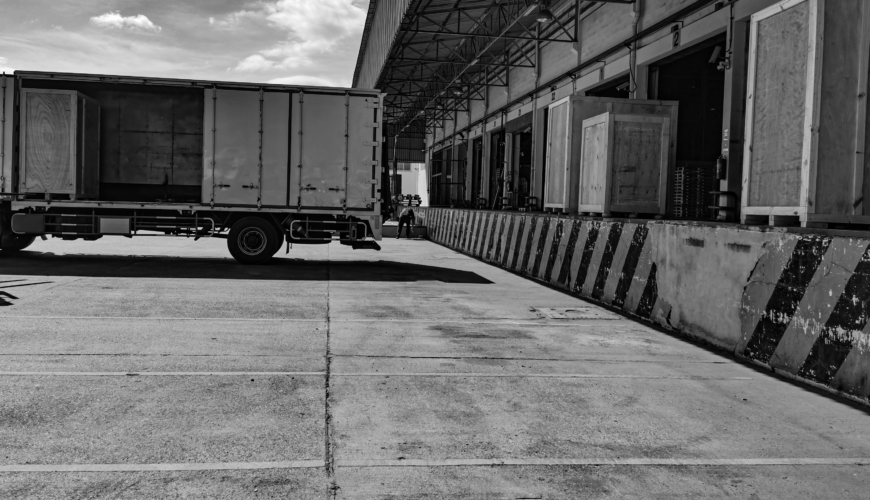
Cross-docking is a warehouse operating strategy in which inbound product is received and transferred directly to outbound shipping with little or no interim storage. In its purest form, the product never enters reserve or pick locations; it is staged briefly, sorted if necessary, and shipped. Flow-through is a closely related concept, typically involving short-duration buffering, sequencing, or consolidation, but still avoiding long-term storage and traditional putaway.
Historically, cross-docking gained prominence in the late 1980s and 1990s, most notably through large retail and grocery distribution networks seeking to reduce inventory carrying costs and accelerate store replenishment. Early implementations were enabled by advances in transportation scheduling, EDI, and barcode scanning, which made it feasible to synchronize inbound receipts with outbound demand. What began as a retail replenishment tactic has since evolved into a broader fulfillment and network optimization strategy used across wholesale, e-commerce, healthcare, and manufacturing supply chains.
Cross-Docking vs. Traditional Putaway Thinking
Traditional putaway is designed for stability and control. The product is received, verified, and stored in a known location, and later retrieved when an order is released. This model works exceptionally well for slow- to moderate-velocity SKUs, uncertain demand, and assortments requiring long dwell times. The tradeoff is time and labor: every pallet or carton handled multiple times adds cost and latency.
Cross-docking and flow-through challenge the assumption that all inventory must be stored before it can be shipped. If demand already exists, or is highly predictable, putaway often adds no operational value. In those cases, it becomes a non-value-added step that consumes labor, space, and time.
Where Cross-Docking Saves Steps and Compresses Time
Cross-docking delivers measurable efficiency when three conditions align: demand is known or imminent, product velocity is high, and inbound timing can be coordinated with outbound commitments.
One of the most compelling—and often underutilized—use cases is active orders for out-of-stock items. In many distribution centers, customer orders are released, picks are attempted, and lines are shorted due to insufficient on-hand inventory. Those orders then sit in backorder status, waiting for replenishment. When the inbound product arrives, traditional processes dictate receiving, putaway, and later wave-based picking, even though demand is already queued.
In these scenarios, cross-docking makes operational sense. The inbound receipt can be pre-allocated to open orders, routed directly to outbound staging, and shipped the same day it arrives. This approach eliminates putaway, reserve replenishment, and secondary picking altogether. The result is fewer touches, faster order closure, and improved customer service without increasing inventory levels.
Additional high-fit scenarios include:
- High-velocity SKUs where inbound volume closely matches outbound demand
- Pre-allocated or ASN-driven receipts tied to stores, customers, or orders
- Promotional or seasonal surges where storage capacity becomes constrained
- Vendor-managed or supplier-direct replenishment programs
- Network balancing moves, such as hub-and-spoke transfers or pool distribution
In each case, the common denominator is that time in storage provides little benefit relative to the urgency of shipment.
The Efficiency Advantage Beyond Speed
While speed is the most visible benefit, the real operational gains come from step reduction. Every eliminated touch—putaway, replenishment, re-pick—translates directly into labor savings. Reduced reliance on storage locations can defer or eliminate capital investment in racking, automation, or building expansion. Shorter dwell times improve inventory accuracy and reduce exposure to damage, loss, or mislocation.
From a network perspective, cross-docking also improves responsiveness. Facilities become flow nodes rather than storage nodes, which is increasingly important as companies push inventory upstream and rely on faster, more frequent replenishment.
What It Takes to Execute Successfully
Cross-docking is not a shortcut; it is a discipline. Successful execution requires:
- Accurate inbound visibility and advanced shipment data
- Tight coordination between transportation, receiving, and shipping
- WMS logic capable of directing product to flow paths rather than reserve locations
- Physical layouts that support rapid movement and staging
- Operational rigor to prevent congestion and misrouting
- Flow-through operations add the complexity of sorting, sequencing, or consolidation, which must be engineered carefully to avoid becoming choke points.
Without these capabilities, cross-docking can quickly degrade into chaos. With them, it becomes a powerful lever for service and cost performance.
The Bottom Line
Cross-docking and flow-through are not replacements for traditional putaway—they are targeted strategies for specific conditions. When demand is known, velocity is high, or orders are waiting on inbound supply, storing product simply delays value creation. In those moments, keeping inventory moving is not just faster; it is operationally smarter.
For organizations facing tighter service windows, labor constraints, and rising fulfillment costs, the question is no longer whether cross-docking works—but whether their network and processes are designed to take advantage of it when it does.