
The tariffs that reshaped U.S. trade policy in 2025 didn’t just raise costs. It forced a fundamental rethink of the supply chain. For decades, distribution networks were engineered around a single north star: efficiency. Companies consolidated suppliers, optimized routes, and squeezed every cost out of global trade lanes. That era is over.
The tariff wave beginning in 2025 didn’t just raise costs. It forced a fundamental rethink of where goods are made, stored, and moved. Today, distribution network design is less about finding the cheapest path and more about building one that can survive the next policy shift overnight.
From Efficiency to Resilience
The old model was elegant in its simplicity: source from the lowest-cost country, consolidate shipments, run lean inventory. Sweeping new tariffs covering everything from consumer goods to raw materials have pushed companies across industries to rework their supply chain strategies from the ground up, adjusting distribution networks and reconsidering the entire end-to-end product flow.
The numbers reflect just how disruptive the shift has been. More than 85% of U.S. importers front-loaded shipments ahead of tariff deadlines to avoid rising costs. That’s not just reactive behavior. It’s a signal that companies were operating networks never designed to absorb this kind of volatility.
The conclusion supply chain leaders have drawn is stark: efficiency without flexibility is just fragility with good margins.
The New Geography of Distribution
Nearshoring and Regional Hubs
Perhaps the most visible structural change is where companies are placing their nodes. Organizations are overwhelmingly prioritizing North American warehousing, regional distribution, and flexible multinode networks over the centralized global models of the past decade.
The U.S.-Mexico-Canada Agreement (USMCA) has emerged as a backbone for this shift. The “China + 1” sourcing strategy has evolved into something more deliberate: a “China + Mexico + U.S.” model that distributes production and inventory across the hemisphere for continuity. Cross-border logistics is no longer a contingency plan. It’s a strategic pillar.
The majority of supply chain leaders have already shifted sourcing away from China toward tariff-neutral countries, and most are building buffer inventory to hedge against continued volatility.
Warehouse Placement Is Being Redrawn
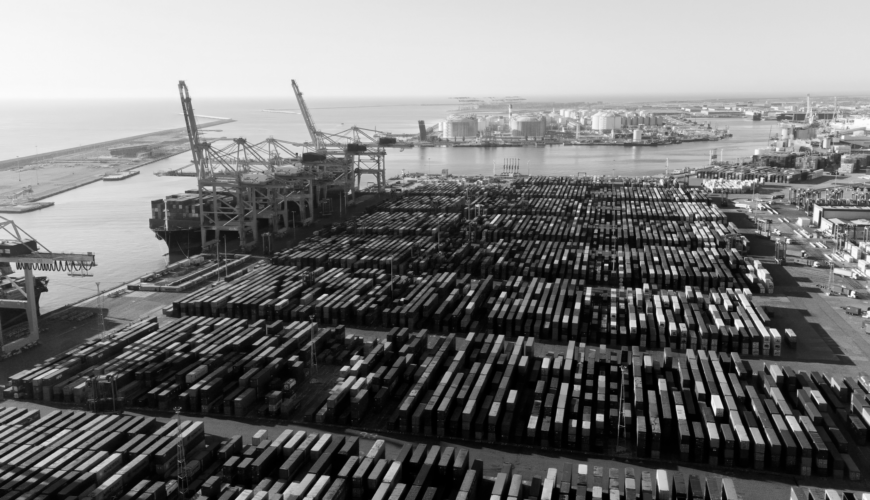
When supplier origins change, distribution center locations have to follow. Companies are now modeling new flows, zones, and distribution points based on where goods will enter the country and where consumers actually are. Port-adjacent warehousing, particularly near key import hubs, is gaining appeal as a way to reduce container per diem costs and maximize turn times.
Retailers are also moving toward flexible multinode networks. Instead of one or two mega-distribution centers, companies are building smaller, regionally dispersed facilities that can serve customers faster and redirect inventory when trade lanes shift.
Supplier Network Design: The End of Single-Source
For decades, procurement strategy meant supplier rationalization: fewer vendors, bigger contracts, lower per-unit costs. Tariff volatility has inverted that logic.
The new imperative is resilience through redundancy. Companies are asking whether their supplier networks can support dual or triple sourcing options rather than concentrating spend with a single vendor. Single-source suppliers, once celebrated for driving down costs, are now recognized as structural vulnerabilities.
This is not just diversification for its own sake. When a tariff change overnight makes a previously cost-optimal supplier unviable, companies with redundant sourcing options can reroute. Those without face production halts, cost spikes, and scrambled distribution plans.
Inventory Strategy: Buffer Stock Is Back
Lean inventory was another casualty of the tariff era. Just-in-time replenishment, designed to minimize carrying costs, assumes a stable, predictable supply environment. That assumption no longer holds.
Companies are now deliberately carrying higher safety stock, not as a sign of inefficiency, but as a hedge against policy shocks. The same logic has extended to transportation contracts, where many importers have moved away from long-term fixed-rate agreements toward shorter-duration or variable-rate terms that preserve flexibility as trade policy continues to shift.
The pattern is consistent across both inventory and transportation: optionality now has real dollar value.
Reshoring and Domestic Manufacturing
For some categories, tariff math has finally tipped the scales toward domestic production. Reshoring, shifting trade lanes, and supplier relocation are reshaping cost structures and logistics flows in ways that will persist long after any individual policy changes.
Apple’s experience illustrates the tradeoffs. Facing increased component costs from China tariffs, the company has accelerated efforts to diversify manufacturing, reportedly planning to shift 15-20% of iPhone and MacBook production to India and Vietnam by 2026. The investment has been significant, topping $1 billion in Indian manufacturing facilities since 2023, and the transition has introduced new complexities including supply chain bottlenecks and longer lead times in some product lines.
For Ford, tariffs on imported steel and aluminum have added an estimated $500 to $1,000 per vehicle in costs. Decisions about where to source materials and where to locate production are now inseparable from distribution network design.
The Role of Technology
One reason companies have been able to adapt faster than expected is pandemic-era investment in supply chain visibility tools. The digital infrastructure built between 2020 and 2022 to manage COVID disruptions has become the foundation for navigating tariff volatility.
Modern platforms now allow supply chain leaders to model landed costs in real time as tariff rates change, identify high-risk SKUs disproportionately exposed to a single tariff regime, flag cost variances before they hit the P&L, and optimize carrier and distribution decisions across a multi-node network. Real-time data has become, in effect, a hedge against policy volatility, allowing shippers to see disruptions and reroute before they cascade into service failures.
What the Network of the Future Looks Like
The distribution network being built today looks fundamentally different from the one designed in 2015. It has more nodes and smaller facilities, regionally dispersed rather than centrally consolidated. It sits closer to end markets, nearshored or domestically sourced where the tariff calculus supports it. It enters through multiple ports to spread risk, relies on flexible carrier arrangements with shorter contracts and variable rates, carries higher safety stock as a strategic asset rather than an inefficiency, and runs on real-time visibility across suppliers, inventory positions, and landed costs.
The shift from efficiency-first to resilience-first isn’t a temporary response to a trade war. It reflects a broader lesson: in a world of persistent policy volatility, the most optimized network on paper is the most fragile one in practice.
The Bottom Line
Tariffs have done what years of supply chain consulting couldn’t: they’ve forced companies to actually redesign their distribution networks for uncertainty rather than just planning for it. The companies investing now in flexible nodes, diversified suppliers, and technology-driven visibility aren’t just managing today’s tariffs. They’re building infrastructure that can absorb whatever comes next.
The distribution network of the future isn’t the cheapest one. It’s the one still running when the rules change again.