
Supply chain automation is no longer a cutting edge concept. Today it is considered a best practice. If you’ve spent any time around the supply chain and logistics industry lately, you’ve felt the shift. The conversations happening at major industry events this spring aren’t about whether to automate. They’re about how fast and how deep. Walking the exhibit halls of the industry’s biggest gatherings this month made one thing clear: the gap between early adopters and those still deliberating is widening fast.
Here’s what the industry is talking about right now, and why it matters to operations leaders at every level.
Supply Chain Automation Robots Aren’t the Future Anymore.
Autonomous Mobile Robots (AMRs) have officially crossed from novelty to necessity. What’s changed isn’t the technology itself. It’s the expectation. Warehouse operators no longer ask “should we have robots?” They’re asking “how many, what kind, and how do we manage them all at once?”
The latest wave of AMR development is focused on versatility and scale. Newer platforms are being engineered to handle multiple task types (picking, sortation, inventory counting, pallet movement) rather than being locked into a single use case. This so-called “polyfunctional” approach means a robot that earns its keep across more of your operation, not just one station.
Fleet management is the other urgent conversation. As facilities expand their robot populations, the challenge of coordinating dozens or hundreds of autonomous vehicles across a shared floor has become a discipline of its own. Unified fleet management platforms, software that can direct AMRs and Automated Guided Vehicles (AGVs) of different makes under a single system, are emerging as a critical infrastructure layer. The goal: predictable, scalable operations that don’t break down when you add another robot to the mix.
AI Has Moved from Copilot to Operator
For the past few years, artificial intelligence in the warehouse largely played a supporting role, surfacing recommendations, flagging anomalies, and helping planners make better decisions. That’s changing.
What industry analysts are calling “agentic AI” is making its commercial debut. These are systems that don’t just analyze and advise. They act. Within defined parameters, agentic AI platforms can dynamically reassign tasks, reroute workflows, and reconfigure operations in real time without waiting for a human decision. Think of it as shifting from a GPS that shows you alternate routes to one that’s actually driving the car.
The data reflects the momentum. Research firm Gartner forecasts enterprise spending on supply chain software featuring agentic AI capabilities will grow dramatically through the end of the decade. Meanwhile, AI-native warehouse management systems are being integrated directly into forklifts, giving operators real-time coaching, safety alerts, and the ability to orchestrate nearby robots, all from the cab.
On the analytics side, AI is doing more than optimizing today’s operations. Advanced systems can now model how a disruption at one node ripples through a multi-tier network and suggest corrective actions before the cascade reaches your dock doors.
The Warehouse Is Becoming Human-Optional
Perhaps the most striking data point to come out of this spring’s industry conversations: new research from Gartner’s Supply Chain practice predicts that by 2030, half of all new warehouses built in developed markets will be designed as “robot-centric” facilities, environments where human workers are present by choice, not necessity.
This isn’t a forecast about robots replacing workers in existing buildings. It’s about how new facilities are being conceived from the ground up. Autonomous facilities can operate with reduced lighting and climate requirements, and they can reconfigure workflows without changing physical infrastructure. The labor economics are driving this: hiring pressure, wage growth, and the ongoing Baby Boomer retirement wave have made human-only operations increasingly difficult to sustain at scale.
For operations leaders, Gartner’s guidance is pointed: don’t wait until you’re building to think about this. The recommendation is to adopt digital twin and simulation tools early, favor software-defined robotics platforms that can adapt over time, and invest in vendor ecosystem partnerships that will support integration and expansion down the road.
ASRS Is Getting Smarter, Not Just Bigger
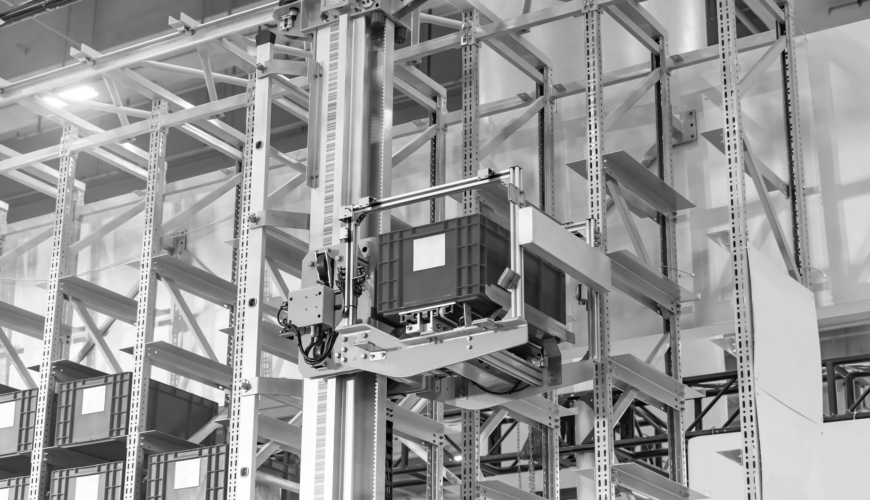
Automated Storage and Retrieval Systems (ASRS) have been a fixture of high-volume distribution for decades. What’s new is the software intelligence layered on top. The real differentiator today isn’t shuttle speed or storage density. It’s how well the system thinks.
Emerging ASRS platforms are integrating AI-powered warehouse management systems that interpret real-time operational data, flag anomalies, and assist with decision-making at the system level. Multi-directional shuttle solutions are replacing older, linear designs, allowing shuttles to operate across both main aisles and storage channels continuously, reducing cycle times and improving operational flexibility, especially in high-mix environments like e-commerce and third-party logistics.
At the same time, warehouses that have already deployed ASRS are focusing on orchestration, getting different automated systems to communicate and coordinate fluidly, rather than running as siloed islands of supply chain automation.
Visibility Got a Whole Lot Sharper
“Real-time visibility” has been a supply chain buzzword for years. What it means in 2026 is substantively different from what it meant in 2020. Knowing where your truck is isn’t enough anymore. The conversation has shifted to knowing where a specific item is, what condition it’s in, and what temperature it experienced, continuously, from origin to last-mile delivery.
Ultra-low-cost smart tags and sensors are enabling item-level tracking without manual scanning. These ambient tracking technologies are particularly valuable for perishable goods and high-value cargo, where condition data matters as much as location data. Pair that with AI-driven analytics, and you have supply chains that don’t just react to problems. They anticipate them.
Yard management is also getting a tech overhaul. New platforms are bringing digital intelligence to the physical choreography of trucks, trailers, and dock doors, an area that has traditionally been managed on whiteboards and gut instinct.
The Investment Is Real, Even If It’s Measured
Not everyone is writing large checks right now. Early 2026 data from industry surveys suggests that near-term supply chain automation spending has moderated after several years of crisis-driven over-investment. The median investment remains modest for most operations.
But the direction is clear. Longer-term confidence is building. More operations leaders expect to increase materials handling and supply chain automation spending over the next two to three years than in prior studies. The organizations making significant moves aren’t doing it incrementally. They’re making meaningful, system-level commitments aimed at labor constraints, cycle-time pressure, and the relentless demands of omnichannel fulfillment.
The gap between those making transformational investments and those taking smaller steps is widening. For operations leaders, the question isn’t whether supply chain automation will reshape your competitive landscape. It already is.
What This Means for Your Operation
The technologies on display this spring aren’t prototypes. They’re deployable now, and the companies integrating them are already seeing results. A few practical considerations as you evaluate your own supply chain automation roadmap:
Think system, not solution. The biggest gains in 2026 aren’t coming from individual machines. They’re coming from software platforms that orchestrate people, robots, and workflows as a unified system. Buy for integration, not just capability.
Software is the differentiator. Whether it’s ASRS, AMRs, or forklifts, the hardware is increasingly commoditized. The intelligence layer, including the WMS, the fleet manager, and the orchestration platform, is where the long-term value is being built.
Design for adaptability. Fixed supply chain automation has its place, but the pace of change in fulfillment demands systems that can be reconfigured without a capital project. Software-defined, modular platforms are earning their premium.
Start with a digital twin. Before committing to a major layout change or robotic deployment, simulation tools allow you to validate the design and optimize performance in the virtual world before spending in the physical one.
The floor is changing. The question is whether your operation is keeping pace.
OPSdesign helps organizations design, optimize, and execute smarter operations. Contact us to learn how the latest supply chain automation strategies apply to your facility