
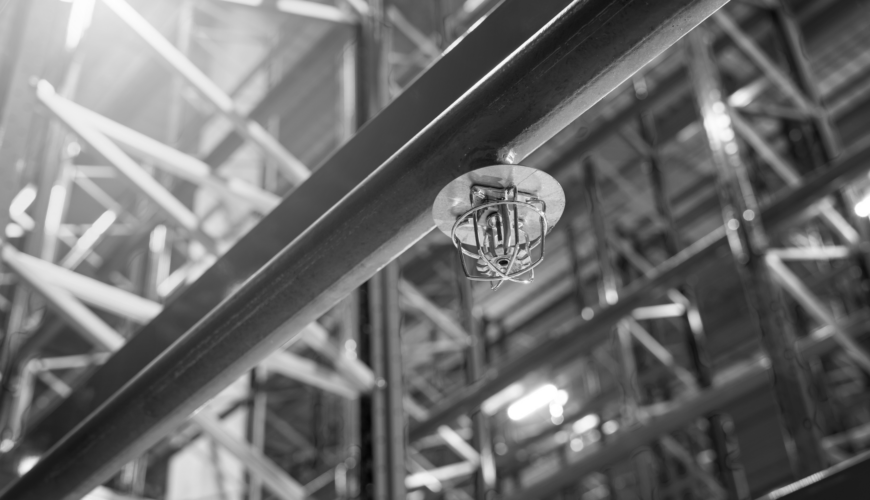
Fire suppression and sprinkler layout should enter the warehouse design process at the same time as building selection, structural engineering, and layout development, not after. Most warehouse design conversations start with the same list of inputs: square footage, clear height, column spacing, dock count, and SKU profile. Fire suppression rarely makes the agenda until the fire protection engineer shows up, and by that time, the layout is already drawn. That sequencing is a mistake that costs real money and real storage capacity.
Fire suppression systems are not background infrastructure. They are a design constraint that shapes how high you can store, what storage systems you can use, how wide your aisles need to be, and how your building structure can be configured. Understanding these relationships before layout development begins is not a compliance exercise. It is smart engineering.
The Three Systems and What Each Demands of Your Layout
There are three primary sprinkler system types used in warehouse and distribution center environments: Control Mode Density/Area (CMDA), Control Mode Specific Application (CMSA), and Early Suppression Fast Response (ESFR). Each operates differently, each carries different design implications, and each interacts with your racking and storage configuration in distinct ways.
CMDA systems are the traditional approach. They are designed to control a fire, to limit its growth long enough for firefighters to complete suppression, rather than to extinguish it outright. CMDA systems are designed around density, the amount of water delivered per square foot of floor area. They are flexible in terms of where sprinkler heads can be positioned relative to obstructions, but that flexibility comes with a trade-off. For high-piled storage, CMDA systems often require in-rack sprinklers, heads installed at intermediate levels within the rack structure itself, because ceiling-only coverage cannot deliver adequate water to a fire burning deep inside tall racks. In-rack sprinklers add cost, add piping complexity, and critically, they constrain your ability to reconfigure rack layout later. Every time you move a rack row, the in-rack plumbing moves with it, or it does not move and you have an abandoned system to deal with.
CMSA systems are purpose-built for specific commodity types and storage configurations. They offer higher K-factor heads, meaning more water flow at a given pressure, than standard CMDA systems and are often used where commodity classifications or storage arrangements fall outside standard CMDA applicability. Like CMDA, CMSA systems may require in-rack protection depending on storage height and hazard class.
ESFR systems are the preferred choice for most modern high-bay warehouses, and for good reason. ESFR heads are designed to suppress a fire rather than merely control it, activating early and delivering a concentrated, high-velocity discharge that drives water down into a developing fire before it reaches full intensity. The operational advantage is significant. ESFR ceiling-only protection can often protect storage configurations that would require in-rack sprinklers under CMDA or CMSA standards, keeping the rack structure clean and preserving layout flexibility. This is why speculative warehouse developers almost universally build to ESFR standards. It makes the building more marketable to a wider range of tenants and uses.
But ESFR is not without its own constraints, and those constraints are directly tied to your layout decisions.
How ESFR Governs Your Storage Height
The most direct way fire suppression affects warehouse design is through storage height limits. ESFR systems are not rated for unlimited storage height. NFPA 13, the governing standard for fire sprinkler systems, sets maximum storage heights based on the commodity class being stored and the ceiling height of the facility. These two variables, ceiling height and commodity class, interact to define the maximum height at which you can store product under a given ESFR system design.
For Class I through Class IV commodities, ESFR ceiling-only systems can typically support storage heights up to 25 feet under certain conditions. Beyond that, in-rack protection is often required regardless of system type. Storage of high-hazard materials, particularly Group A plastics such as expanded or unexpanded plastics, carries more restrictive limits and higher design pressures.
The critical figure that most operations teams do not internalize is the clearance requirement. ESFR sprinklers require a minimum 36-inch clearance between the sprinkler head deflector and the top of storage. CMDA and CMSA systems carry an 18-inch minimum clearance requirement under NFPA 13. This is not a preference. It is a code requirement. Violating it means the sprinkler system cannot function as designed.
What that means in practice is simple. A warehouse with 36-foot clear height cannot store product at 36 feet. Under ESFR, the top of pallet load must be at least 36 inches below the deflector. The deflector itself sits some distance below the deck of the roof. When you account for the structural depth of the roof and the sprinkler drop, the usable storage height is meaningfully less than the ceiling height figure in the lease. This gap is one of the most common sources of surprise in warehouse layout projects and one of the most avoidable.
The math is straightforward. If your building has a 36-foot clear height and your ESFR deflectors hang at 34 feet, your maximum top-of-storage is 31 feet, which is 34 feet minus 3 feet of required clearance. That is the height constraint fire protection imposes on your rack design before you have selected a single beam level. Work backward from there to set your pallet load height and your beam tier layout, and the result may be fewer storage positions than the square footage calculation suggested.
Commodity Classification Changes Everything
Most warehouses store more than one product type. The fire protection system must be designed for the worst-case commodity in the facility. That means the most hazardous material present governs the design criteria for the entire building.
NFPA 13 classifies storage commodities on a scale from Class I, noncombustible or limited combustibility materials in noncombustible packaging, through Class IV, materials with significant combustibility in packaging that adds to the hazard, and Group A Plastics, which carry the highest fire hazard of any commonly stored commodity. Group A Plastics include foam, polystyrene, ABS, and similar materials, products found in virtually every consumer goods supply chain.
The practical consequence is that a facility storing primarily Class II product with a single SKU group of cartoned expanded polystyrene must be designed as a Group A Plastics facility throughout. The fire protection system does not change room by room. It is uniform across the protected area. Operations teams that say “we only store a small amount of that product” are not offering a solution. They are describing a compliance problem. Either the system is upgraded to protect the highest-hazard commodity, that commodity is segregated in a separately protected area, or it does not belong in the facility.
This is a design-time conversation, not a lease-signing-time conversation. Commodity classification should be established during the programming phase of a warehouse design project, before building selection or layout development begins, because it determines the sprinkler system specification and the system specification determines what storage configurations are permissible.
Structural Systems and ESFR Compatibility
One of the less-discussed relationships in warehouse design is the interaction between fire suppression and structural systems. ESFR sprinklers have specific requirements for unobstructed spray pattern development. Obstructions, beams, purlins, ductwork, conduit, light fixtures, can interfere with head performance and may require additional heads to compensate, which drives up system cost and complexity.
Concrete double-tee roof construction, a common choice for its efficiency and span capability, creates a particular challenge. Because the tee stems create channels, NFPA 13 may require ESFR sprinklers in every channel when the structural members exceed a certain depth. When tees are spaced tightly, as they often are for structural efficiency, this can push sprinkler spacing below the minimum separation distance the code requires between ESFR heads. The result can be a situation where the preferred structural system and the preferred sprinkler system are mutually incompatible. Resolving it may require a smooth ceiling installed below the structure, adding cost, or a different structural approach, also adding cost.
This is not a hypothetical scenario. It is a documented trap in warehouse design that catches projects when the structural engineer and fire protection engineer are working independently rather than together. Getting those two disciplines in the same conversation during design development, before the structural system is committed, is how you avoid an expensive redesign.
Column spacing carries a similar implication. Rack layout is typically developed to fit within the structural bay and avoid columns in aisle positions. Fire protection head placement must also work within that grid. If the two are not coordinated, the result is sprinkler heads located in suboptimal positions relative to the storage configuration, or additional heads required to achieve coverage. Neither outcome is free.
The In-Rack Decision and Its Layout Consequences
When ESFR ceiling-only protection is not sufficient, because storage height exceeds ESFR limits for the commodity class or the building ceiling height is too low to allow ESFR at the required storage height, in-rack sprinklers become necessary. This decision has significant implications that go beyond the cost of the piping.
In-rack sprinklers are installed at intermediate levels within the rack structure. NFPA 13 specifies where within the rack height they must be positioned. The piping connecting those heads runs through the rack uprights and along the bays. The result is a sprinkler system that is physically integrated into the storage structure, and that integration is not easily undone.
Every time the rack layout changes, the in-rack system must change with it. Removing a rack row, adding a row, changing bay orientation, or adjusting aisle width all require corresponding changes to the in-rack plumbing. This requires a fire protection contractor and, depending on the extent of the change, a new permit and inspection. In high-velocity operations that regularly reconfigure storage to respond to changing product mix or volume, in-rack systems are a meaningful operational constraint. They do not make reconfiguration impossible. They make it slower and more expensive.
The alternative worth examining before committing to in-rack protection is building height. In some cases, the cost of designing and maintaining in-rack sprinklers over the life of a lease is greater than the cost premium of a taller building that supports ESFR ceiling-only protection. That trade-off deserves to be modeled explicitly, not assumed.
Water Supply and Its Hidden Site Constraints
ESFR systems require significantly more water pressure and flow than conventional sprinkler systems. This is not a minor difference. ESFR systems may require design pressures of 50 psi or more at the head, and flow rates that municipal water mains in some industrial areas cannot reliably deliver without supplementation.
The water supply question must be answered at the site selection stage. A building with insufficient municipal water supply to support an ESFR system requires a fire pump. That means pump room space, electrical infrastructure, and maintenance costs that do not appear in the base lease. In some cases, a site may require a dedicated storage tank in addition to or instead of a pump, depending on local supply characteristics.
This is a site constraint that is easy to overlook when evaluating a building for lease or purchase. Comparing two facilities on square footage, clear height, and lease rate while ignoring fire protection water supply is comparing different things. The facility with adequate water supply is not equivalent to the facility that requires a $200,000 fire pump installation, even if everything else looks the same on paper.
Aisle Width: Where Fire Code and Operational Design Meet
NFPA 13 and local fire codes establish minimum aisle width requirements that may differ from the aisle widths your storage system would otherwise prescribe. For ESFR systems, minimum aisle widths vary based on commodity class and storage height. The 2016 edition of NFPA 13, for instance, specifies minimum aisle widths for certain high-hazard storage configurations. Local fire codes, enforced by the Authority Having Jurisdiction (AHJ), may impose additional requirements.
Beyond the fire code minimums, aisle widths affect airflow patterns during a fire, which in turn affects how sprinkler heads activate and perform. This is why the fire protection engineer needs to see the rack layout, not just the building drawings. A rack configuration that creates restricted airflow conditions in certain aisle configurations can compromise suppression performance in ways that are not captured by simple code compliance checks.
The AHJ’s role deserves particular emphasis. NFPA 13 sets a national baseline, but the Authority Having Jurisdiction, typically the local fire marshal or fire prevention bureau, has interpretive authority and may apply requirements more stringently than the standard requires. The AHJ’s position on specific design questions should be confirmed early in the design process, not discovered during permit review.
The Right Sequence
Fire suppression should enter the warehouse design process at the same time as building selection, structural engineering, and layout development, not after. The decisions made in each of these areas constrain what is possible in the others, and the cost of resolving conflicts increases with every step taken before the conflicts are identified.
The commodity classification should be established before the building is selected. The building’s water supply, ceiling height, and structural system should be confirmed before the sprinkler system type is specified. The sprinkler system type should be confirmed before the rack system and storage height are finalized. The rack layout and the sprinkler head layout should be developed in coordination, not sequentially.
This is how design engineering is supposed to work, as an integrated discipline rather than a series of independent handoffs. When fire suppression is treated as a late-stage compliance item, it produces predictable problems: storage heights that underperform the building’s clear height, in-rack systems that limit operational flexibility, structural choices that conflict with suppression requirements, and water supply costs that were not in the project budget.
None of that is inevitable. It is the predictable result of a sequencing problem that better project management and integrated design discipline can solve.
OPSdesign Consulting designs warehouse, distribution, and fulfillment operations from first principles, with fire protection, structural systems, and storage engineering developed as an integrated whole. If your next project involves high-bay storage, commodities that push into Group A Plastics classification, or a building where the relationship between clear height and usable storage height is unclear, contact us to discuss how we approach it.