

Budget season makes a warehouse look more efficient than it is. Labor, rent, leases, utilities, and maintenance land in tidy line items that are easy to compare and trim. What fails to appear is the cost of the problems the building seems to create each day. Those costs are legitimate, and often large. They just get booked to other departments, and nobody traces them back to the layout or process that caused them.
So the business keeps paying the bill for symptoms while the cause stays in place. Whether next year’s budget is still open or already locked, it is worth hunting down the spending that starts in the warehouse but lands somewhere else.
If you own the P&L rather than the building, this is your problem too. Most of these costs sit in budgets you review.
Overtime that is really a design problem
Most operations treat overtime as a staffing cost. When volume rises, hours go up, and next year’s budget assumes a similar premium. What that misses is how much overtime comes from work that takes longer than it should.
Long travel paths, congested aisles, or a pick sequence that doubles back on itself add minutes to every order. In normal weeks those minutes are absorbed quietly. At peak they compound into extra shifts and weekend coverage, and the conversation turns to hiring or temp labor when part of the fix is in the floor plan.
Before budgeting, split overtime into two piles: hours driven by volume and hours driven by design. If units per labor hour fall as volume climbs, the layout is not scaling, and that cost will come back every year until someone changes it.
Mispicks and the cost of fixing errors downstream
A picking error costs far more than the item that went out the wrong door. It triggers a customer service contact, return freight, a replacement order, a second pick and pack, and often a credit to keep the account happy. Customer service absorbs the calls, transportation absorbs the freight, and finance absorbs the credits. The warehouse budget sees almost none of it.
Many errors trace back to the environment, not the people: look-alike items slotted side by side, poor labeling, weak lighting, and pick faces never reslotted as the product mix changed. Once leaders see the fully loaded cost of one error, a small gain in accuracy can be worth as much as a meaningful cut in direct labor.
Turnover and the training bill that never ends
Turnover is usually treated as an HR issue, with recruiting costs in an HR budget. The operational cost is larger and rarely measured. Every new associate spends weeks below full productivity, pulls time from supervisors and experienced coworkers, and makes more mistakes while learning.
Work design drives retention more than many leaders assume. Excessive walking, awkward reaches, heavy lifts at poor heights, and constant congestion wear people down. Processes that live only in the heads of a few veterans make the first weeks frustrating and push new hires out before they reach full speed. Clear, current standard work and better ergonomics reduce turnover and make the next hire cheaper to train.
Extra touches and double handling
Every time a pallet or carton moves without adding value, the operation pays for labor, equipment time, and risk of damage. In many buildings, inventory gets staged in an aisle because reserve is full, moved to make room, consolidated later, and relocated again when the slotting is finally corrected.
None of those moves is a line item. They hide inside general labor hours and equipment wear, and they grow quietly as the facility fills up and workarounds become routine. Track touches per unit, even roughly. Product handled three or four times before it ships usually means the building has outgrown its original design.
Dock congestion, detention, and space workarounds
Undersized or poorly sequenced docks make trucks wait. Carriers bill detention, appointments slip, and inbound freight backs up into the yard. Those charges land in transportation, where they are treated as a carrier problem rather than a facility constraint.
Space shortages follow the same pattern. Trailer storage, short-term outside warehousing, and temporary leases each solve an immediate capacity problem, and each gets budgeted on its own. Added together, they can rival the cost of reworking the main building to use its space better. Because they arrive one decision at a time, nobody sees the total.
The hidden cost checklist
It does not take a perfect accounting exercise. A reasonable estimate from data you already have is enough to show where each cost is hiding.
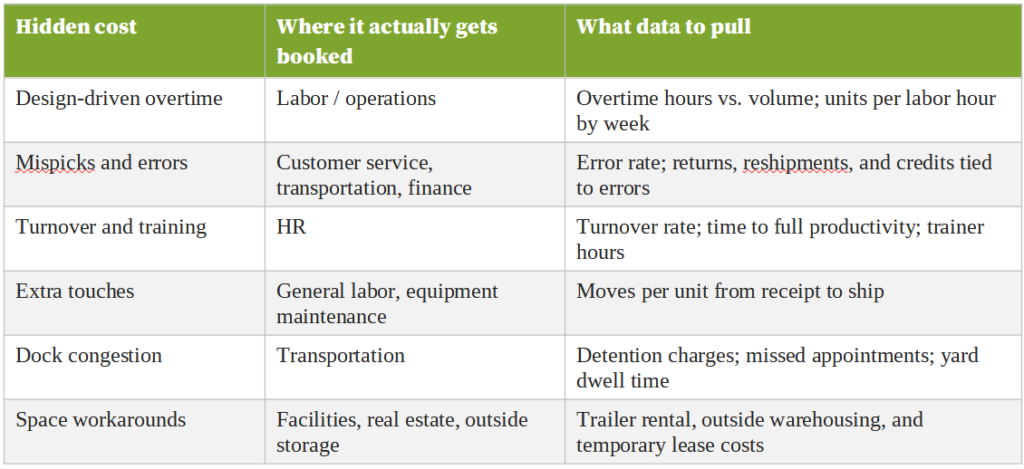
Once those numbers sit side by side, the budget conversation changes. A design assessment, a reslotting project, or a targeted layout change stops looking like new spending and starts looking like a way to remove costs the business already pays every year.
If your budget is still open, now is the time, while last year’s data is fresh and every account is under review. If it is already locked, these costs do not stop. They become the case for reallocating spend in Q1, before the money is committed elsewhere.
The OPSdesign® Advantage
OPSdesign’s supply chain and industrial engineers find the costs your budget cannot see by analyzing material flow, labor performance, order profiles, and space utilization. As a vendor-independent firm, we do not sell equipment, so our recommendations follow your return, not a product line. Want to know what your building is really costing you? Our fixed-fee hidden cost diagnostic delivers a quantified answer in two to four weeks. Contact us at opsdesign.com.


